
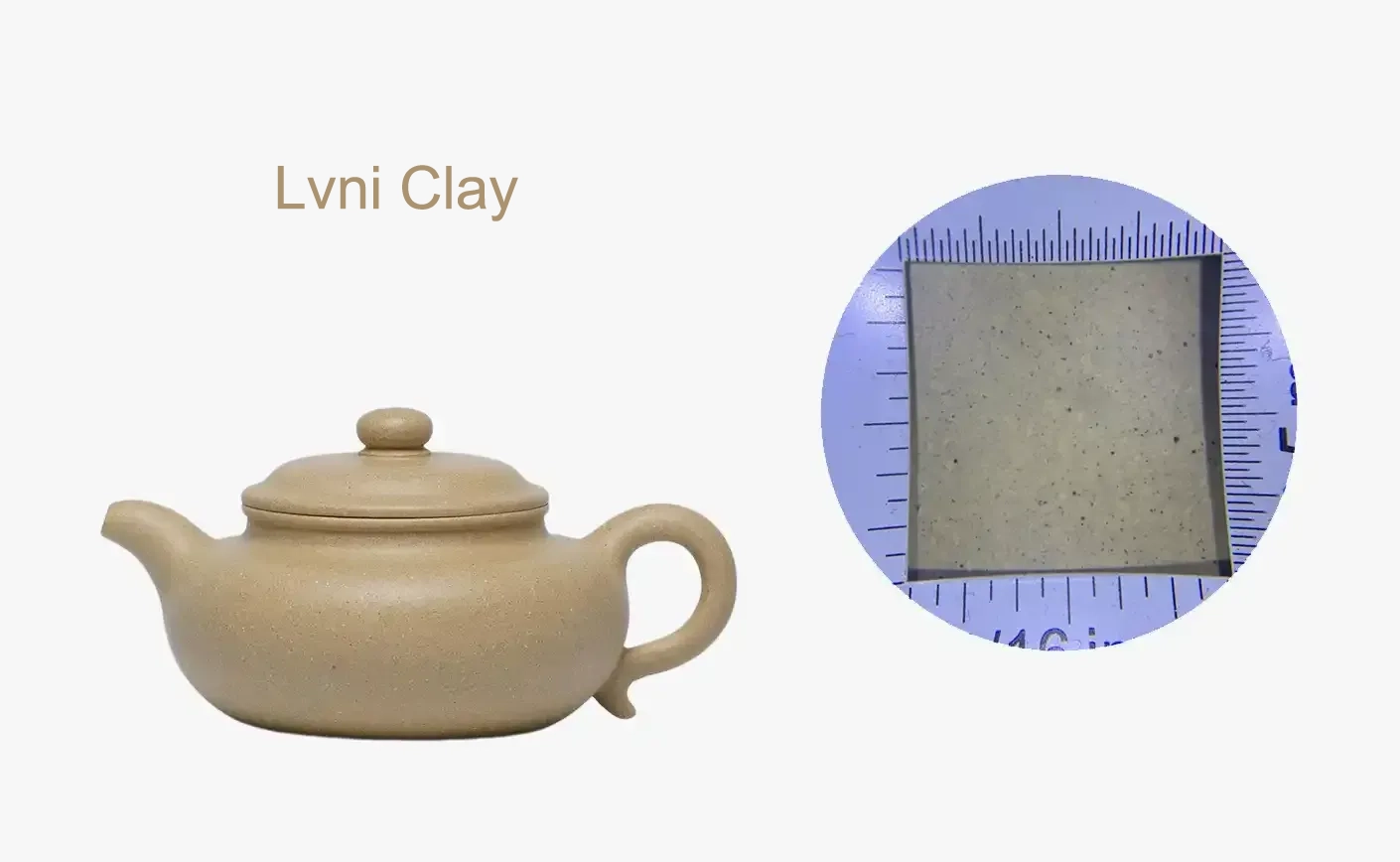
The Geological Myth vs. Mineral Reality of Lvni
In the global market of Zisha connoisseurship, no material is shrouded in as much aesthetic and chemical misinterpretation as Lvni. To the uninitiated, the name—literally translating to "green clay"—evokes expectations of a vibrant, verdant ceramic vessel. However, within the framework of authentic mineralogy, raw Lvni is a highly localized, pale gray-green argillaceous siltstone found predominantly as a microscopic argillaceous stratum within the larger sedimentary structures of Dingshu Town, Yixing. It represents a classic "clay within clay" (泥中泥) phenomenon, typically tracking as an ultra-thin interstitial layer measuring only a few centimeters to tens of centimeters in thickness, nested between massive formations of Zini or Duanni. To understand its fundamental position within the broader taxonomy of authentic Yixing minerals, one may consult the comprehensive matrix outlined in Zisha Clay Types.
The mineral composition of true Lvni is characterized by an exceptionally high concentration of hydromica (illite), combined with quartz silt and kaolinite. Crucially, its elemental profile features elevated levels of aluminum oxide (Al₂O₃), often fluctuating between 24% and 30%, coupled with a conspicuously low iron oxide (Fe₂O₃) content, typically remaining under 2%. It is this specific low-iron, high-aluminum chemistry that dictates its fired coloration. When subjected to the oxidative atmosphere of a modern or traditional kiln, the lack of iron prevents the clay from turning red or purple; instead, it vitrifies into a striking spectrum ranging from delicate creamy white, pale primrose yellow, to an understated greenish-gold, traditionally termed "pear-skin yellow" (梨皮黄).
Conversely, the intense, grass-green or jade-green Yixing teapot variants frequently encountered in commercial tourist markets are almost universally the product of chemical adulteration. These industrial counterfeits utilize low-grade, non-Zisha white clays artificially dosed with industrial chromium oxide green (Cr₂O₃) pigments. This chemical intervention completely overwrites the natural pore dynamics of the material, compromising both structural integrity and toxicological safety. True collectors must prioritize biochemical purity and historical authenticity, a standard rigorously enforced through the analytical metrics established in Purity & Safety.
Physically, Lvni exhibits a fascinating proximity to Duanni due to their shared pale coloration, yet they represent entirely distinct geological extractions. While Duanni is inherently a composite, sand-heavy sandstone blend featuring coarse quartz granules distributed across a multi-colored matrix, Lvni is an independent, uniform siltstone layer possessing far superior mineral purity, higher oiliness in its raw state, and a significantly finer, more homogenous crystalline structure after firing.
The Sintering Paradox: Thermal Mechanics and Firing Challenges
Transforming raw Lvni into a structurally sound Yixing teapot requires navigating an incredibly unforgiving thermodynamic envelope. The primary engineering challenge stems directly from its high kaolinite and aluminum oxide profile, which raises the necessary vitrification threshold to a critical zone of 1170°C to 1220°C. Within this narrow thermal window, the clay transitions from an under-fired, porous state to an over-fired state marked by surface blistering and structural sagging. The margin for error is virtually nonexistent, representing one of the most perilous operational challenges in modern Kiln Science.
Because the material possesses high internal "sandiness" (砂性)—a structural characteristic denoting a low proportion of highly plastic binder clays relative to rigid silicate particles—it exhibits a severe lack of tensile strength during the shaping phase. When a master craftsman attempts a Fully Handmade fabrication, the clay resists severe structural deformation, demanding an exquisite, light-touch paddle technique to prevent micro-fracturing along the temporal walls. The physical stress inside the kiln is compounded by an exceptionally high linear shrinkage rate, which frequently induces spontaneous catastrophic cracking during the cooling cycle. This physical fragility explains why historical Lvni vessels are predominantly smaller shapes—such as the delicate Shuiping or the refined Xiaoying—which minimize structural surface tension during thermal contraction.
To mitigate these extreme manufacturing risks without resorting to chemical fluxes, historical artisans developed the technique of structural layering or compounding. Instead of forming the entire body from pure, structural Lvni, a highly refined slip of Benshan Lvni is meticulously painted as an exterior veneer over a structurally resilient core of Zini or Duanni before firing. This advanced dual-body engineering marries the mechanical stability and thermal shock resistance of the underlying purple clay with the exquisite, jewel-like surface texture of the green clay. When evaluating these rare vessels on the secondary market, advanced collectors utilize specialized physical examinations to distinguish between solid-body and veneered structures, applying the precise diagnostic frameworks found in the Forensic Markers archive.
Thermodynamics & Pore Structure: The Science of Lvni Tea Pairing
From the perspective of fluid dynamics and thermal mass, a fired Lvni matrix behaves as an advanced thermodynamic regulator. Because it possesses a complex, multi-modal distribution of both open and closed micro-pores, its internal structural layout differs fundamentally from highly vitrified, high-density clays like Zhuni. While Zhuni exhibits a massive firing shrinkage that collapses most open pore networks—resulting in high thermal conductivity and an aggressive reflection of volatile aromatics—Lvni retains an open, highly breathable pore system that strikes an ideal equilibrium between heat retention and ambient dissipation.
This micro-structural architecture yields a highly specific chemical mitigation effect during the tea infusion process. The expansive inner surface area of the Lvni walls acts as a selective molecular filter, absorbing high-molecular-weight polyphenols and harsh, aggressive tannins without stripping away the delicate, highly volatile essential oils that constitute a tea's top-note aroma profile. This specific thermodynamic profile and chemical absorption capacity make it an unparalleled tool for brewing teas with high flavor intensity but inherent structural bitterness, a phenomenon explored in detail within the specialized data maps of Lvni Tea Pairing.
| Tea Varietal | Thermodynamic Synergy | Micro-Porous Extraction Mechanism |
|---|---|---|
| Dancong Oolong | Moderate, steady heat release prevents leaves from stewing. | Blunts the aggressive, astringent edges while elevating structural floral aromatics. |
| Sheng Pu-erh (Young) | High thermal mass preserves core extraction temperatures. | Absorbs excess sharp bitterness and smoky processing artifacts, smoothing the mouthfeel. |
| White Tea (Silver Needle) | Gentle thermal gradient protects fragile, unfermented buds. | Preserves the delicate, amino-acid-driven sweetness and clean, pale liquor clarity. |
Whether processing a finicky Dancong or a vibrant young Sheng Pu-erh, the physical vessel shape works in tandem with the material. Collectors searching for the ideal mechanical pairing can browse verified, artisan-crafted configurations within the curated Lvni Teapots catalog.
The Metamorphic Patina: Maintenance and Micro-Structural Evolution
The true joy of owning an authentic Lvni vessel lies in witnessing its long-term physical metamorphosis, a transformative process known to seasoned tea masters as "nourishing the pot" (养壶). Because fired Lvni possesses a naturally matte, highly absorbent, light-colored surface texture, its optical properties are uniquely sensitive to the cumulative deposition of tea solids, polyphenols, and essential oils. Over months of consistent brewing, these organic compounds slowly migrate into the open micro-pores of the clay matrix, undergoing gradual oxidation and stabilization.
This micro-structural saturation fundamentally alters how light interacts with the ceramic surface. The initial dry, chalky, and slightly reflective pale-yellow exterior shifts toward an deeply lustrous, translucent, and jade-like patina (包浆). The pot develops a warm, visual depth that appears to glow from within, moving from a sterile mineral state to an organic, living partner in the tea ritual. To understand the underlying physics of this material transformation and maximize its aesthetic speed, reference the protocols detailed in Patina & Maintenance.
However, due to the light baseline coloration of the clay, Lvni is highly susceptible to unscientific seasoning methods or negligent maintenance. If tea liquor is allowed to pool externally on the lower sections of the pot body, or if the vessel is not thoroughly dried after use, it will develop uneven, unsightly dark brown organic staining (茶渍). These surface blemishes lock into the outer pore structures, masking the natural beauty of the mineral and proving incredibly difficult to safely extract. To prevent these maintenance failures and protect your investment against catastrophic structural damage caused by rapid atmospheric changes, ensure strict adherence to the thermal handling frameworks established in Thermal Shock Safety.
FAQ
Why is authentic Lvni not grass-green after firing?
Authentic raw Lvni is named for its pale, greenish-gray appearance in its unrefined, raw rock form. Chemically, it contains very high concentrations of aluminum and very low concentrations of iron. When fired in an oxygen-rich kiln environment, this specific chemical makeup causes the clay to vitrify into a beautiful range of creamy ivory, warm primrose yellow, or greenish-gold. Any teapot displaying an intense, synthetic grass-green color has been artificially contaminated with industrial chromium oxide green pigments.
Why are fully handmade Lvni teapots exceptionally rare and prone to tiny hairline fissures?
Because Lvni exhibits low structural plasticity and high internal sandiness, it possesses very little tensile strength when wet. During a Fully Handmade forming process, the clay resists severe manipulation, placing immense mechanical stress on the seams. Furthermore, its extremely high linear firing shrinkage rate causes massive physical contraction inside the kiln. This often manifests as microscopic hairline cooling cracks around the handle, spout junctions, or lid rims, resulting in an exceptionally low successful yield rate for complex or large shapes.
How do I prevent thermal shock in a Lvni teapot during winter brewing?
Due to the unique dual-pore network of Lvni, rapid, uneven thermal expansion can cause structural failure if boiling water is suddenly introduced to a cold pot body. To ensure safety, always preheat the vessel gently. Fill the teapot entirely with warm water (approximately 40°C to 50°C) and pour water over the exterior walls first. Allow the body temperature to equalize for 30 seconds before discarding the warming water and proceeding with boiling water for tea extraction.