
Introduction: The Symbiotic Stratum of Yixing
Building upon our physical analysis of Zini & Dicaoqing as the structural geological bedrock of Huanglongshan, we now turn our focus to Yixing's fascinating multi-mineral formations. In the broader taxonomy of the Zisha Clay Types archive, certain materials do not exist as isolated single-mineral veins. Instead, they form through deep-crust interbedded sedimentation. The prime example of this geological phenomenon is Duanni, a celebrated symbiotic ore where green clay (Lvni) and purple clay (Zini) naturally fuse at a molecular level over hundreds of millions of years.
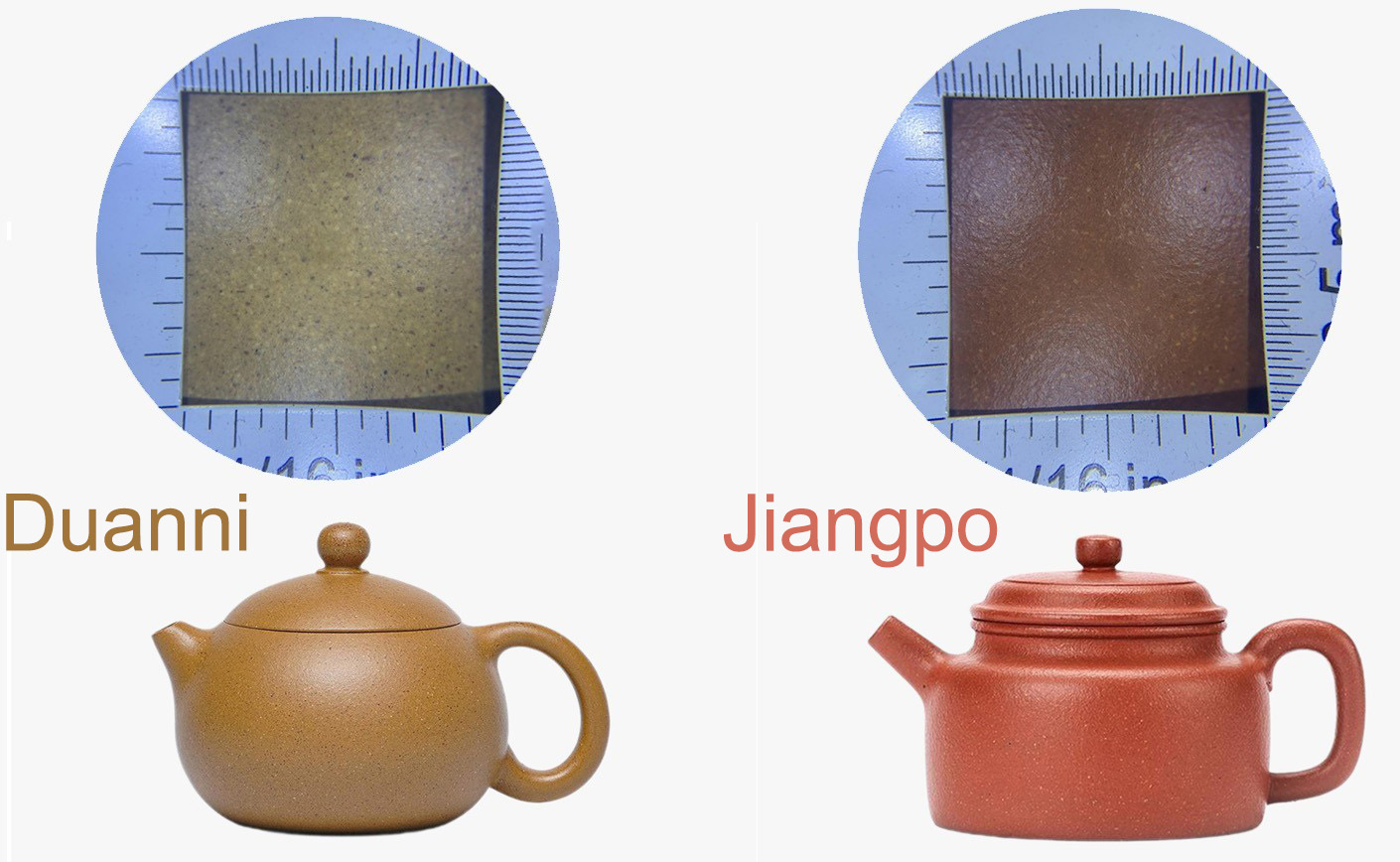
Within this pale yellowish-green layer sits Goldn-duanni, an exceptionally pure, high-refractory variant mined from specific geological blocks within the Benshan area. This profile is completed by Jiangpo, a legendary, accidentally discovered mixed-vein clay that naturally blends three distinct mineral phases: red clay, green clay, and purple clay. For the collector analyzing authentic Duanni Teapots and mineral-rich Jiangpo Teapots, these materials represent nature's finest porous filter media. Their mechanical and thermal performance properties are directly tied to their unique high-silicon, low-iron mineral chemistry.
Mineralogical Architecture and High-Silicon Porosity
From a materials science perspective, the defining characteristic of the Duanni family is its high concentration of quartzose sand particles combined with a low total percentage of iron oxide. While a standard Zini ore contains up to 9% iron oxide ($Fe_2O_3$), raw Duanni typically carries less than 2% to 3%. Conversely, its silicon dioxide ($SiO_2$) content frequently surpasses 65% to 70%, creating a highly refractory, silica-dense structural matrix.
When fired to maturity, this unique mineral balance yields a highly distinctive dual-pore structure with an exceptional open porosity rate. While other clays experience significant vitrification (glass-like sealing) under high heat, the quartz grains in Duanni remain structurally stable. This leaves an intricate network of interconnected micro-voids, elevating the pot's total open porosity to an impressive 13% to 16%. This highly porous matrix functions essentially as a thermal and molecular sponge during the brewing process.
To see how these high-silicon properties shift across the three primary varieties, we can examine their raw physical profiles side by side:
| Clay Profile Metric | Classic Duanni | Golden-duanni | Natural Jiangpo |
|---|---|---|---|
| Geological Matrix Type | Symbiotic Siltstone (Lvni + Zini) | Ultra-Pure Clay-Rich Claystone Layer | Mixed-Vein Clay (Zini + Hongni + Lvni) |
| Average Total Porosity | 13.2% – 14.8% | 14.5% – 16.2% | 11.5% – 13.0% |
| Silicon Dioxide ($SiO_2$) | 65% – 68% | 68% – 72% | 58% – 62% |
| Linear Firing Shrinkage Rate | ~11% – 13% | ~13% – 14.5% | ~9% – 10.5% |
| Optimal Sintering Window | 1170°C – 1200°C | 1190°C – 1230°C | 1140°C – 1170°C |
This structural arrangement sets up a stark contrast with the low-porosity, highly vitrified clays analyzed in our guide to Hongni & Zhuni. While those denser clays rapidly project volatile top notes into the air, the high-porosity matrix of Duanni acts as a natural buffer. It absorbs aggressive, bitter elements and smooths out heavy, astringent compounds in the liquor.
Decoding Golden-duanni: The Purest Saturation of Benshan
Among the various sub-types of symbiotic ores, Golden-duanni stands out for its striking, pure golden hue. This vivid color is not the result of artificial additives; it stems from a specific chemical profile low in iron but rich in titanium dioxide ($TiO_2$). Found primarily within the elite mining zones of the original Huanglongshan deposit, this material requires careful, precise temperature management during the firing process.
Under a strict oxidative firing atmosphere, the trace iron within the clay converts into stable ferric oxide (trivalent ferric iron), while the titanium acts as a natural color modifier, shifting the tone from a pale straw yellow to a deep, warm metallic gold. However, achieving this color profile requires a very high sintering temperature, often exceeding 1200°C. If under-fired, the clay matrix fails to fully mature, leaving it vulnerable to structural weakness and structural instability.
Forensic Insight: Because Golden-duanni features an exceptionally high open porosity rate of up to 16.2%, its raw surface texture feels notably soft and granular to the touch. This high concentration of exposed micro-voids means the clay acts as a powerful physical filter. When paired with dark, heavily oxidized teas, it can rapidly trap and accumulate organic tannins across its pale surface—a process collectors must manage carefully to prevent uneven staining.
When examining a genuine Shipiao or Dezhong crafted from true Golden-duanni, the fired clay should display a matte, non-reflective golden-yellow patina. Under magnification, you will not see a uniform yellow surface; instead, it reveals a complex mix of translucent quartz granules and dark purple-red iron specks. This natural variation is a core indicator of pure ore, detailed further in our guide to Forensic Markers.
Jiangpo Clay: The Accidental Trinity of Three Veins
In contrast to the deliberate mining of classic symbiotic layers, the discovery of Jiangpo clay was a complete geological accident. In the early 1990s, during the construction of the Taodu Road cutting through the ridge line connecting Huanglongshan and Qinglongshan, heavy excavators uncovered an unusual transitional fault zone. This localized zone contained a unique, naturally blended composite vein where Zini, Hongni, and Lvni were compressed into a single, tightly fused stratum.
Because it naturally contains minerals from all three major Zisha groups, Jiangpo clay exhibits an extraordinary mix of physical and visual properties. Its firing shrinkage rate is moderate (9% to 10.5%), and its iron content sits perfectly between that of red clay and standard purple clay. This intermediate composition gives fired Jiangpo a distinct color profile: a warm, rich orange-red background speckled with subtle yellow and dark purple grain inclusions.
This natural blend of three distinct material phases yields a finished surface with a complex, multi-layered texture. When a craftsman shapes a round vessel like a Xishi or a crisp, geometric form like a Sifang using authentic Jiangpo clay, the pot develops a unique aesthetic. The larger structural granules catch the light at slightly different angles, creating a rustic, tactile surface that ages beautifully over time.
Pyro-Thermodynamics and Advanced Tea Pairing Mechanics
The practical advantage of these symbiotic clays lies in how their mineral compositions and pore networks alter brewing dynamics, a concept explored deeply in Infusion Physics. Because Duanni and Golden-duanni feature high silica content and a thick pore structure, they provide excellent thermal insulation and high heat capacity. This enables them to maintain a highly stable, uniform water temperature during long extraction cycles.
This combination of high heat retention and excellent chemical adsorption makes these clays exceptional tools for tempering bold, robust, or highly astringent teas. For specific advice on matching vessels with leaves, see our Duanni Tea Pairing guide.
- Heavy-Roasted Rock Teas (Wuyi Yancha): The porous walls of a Duanni vessel soften intense, harsh charcoal-fire notes, smoothing out aggressive edges while allowing the rich, underlying mineral complexity to shine through.
- Aged Raw Pu-erh & Old White Teas: The high open porosity helps filter out damp, stale storage notes, lifting the clean sweetness of older leaves and producing a smooth, round, and highly balanced texture.
Over extended periods of regular brewing, the oils and polyphenols within the tea liquor slowly migrate into the open pore spaces, as detailed in Seasoning & Maintenance. Because these light-colored clays are highly porous, they absorb organic compounds readily. This steady absorption coaxes out a soft, jade-like gloss from the deep golden or orange-red surface, rewarding the patient collector with a rich, glowing patina that showcases the unique physical properties of Yixing's symbiotic ores.
FAQ
Why do Duanni and Golden-duanni teapots easily "spoil" (turn greyish/dirty) if paired with the wrong tea?
This staining happens because of the clays' high open porosity (13% to 16.2%) and light surface color. If paired with dark, heavily oxidized liquors like Shou Pu-erh or black teas, the large macro-pores quickly absorb intense dark tannins. If the pot is left unrinsed, these dark compounds can stain unevenly, making the pale yellow clay look dull or greyish. To maintain a clean, bright patina, it is best to pair these pots with lighter teas or rinse them thoroughly with boiling water immediately after use.
Is "Spitting Black" a structural defect or proof of an authentic dual-pore structure?
It is a natural physical result of under-firing, not a structural defect. When a Duanni pot is fired near the lower limit of its sintering window, its dual-pore structure remains completely open and highly absorbent. Over months of use, dark tea organic molecules lodge deep inside these microscopic gaps. Because the under-fired clay matrix lacks the density to completely trap these molecules, they can gradually track back to the surface, creating dark, charcoal-grey patterns that reveal the genuine, high-porosity nature of the clay.
How does the multi-grain visual texturing of genuine Jiangpo clay separate it from blended factory clays?
Authentic Jiangpo is a natural symbiotic ore, so its multi-colored mineral grains (purple, red, and yellow-green) are bound together directly within the single clay matrix. When fired, these particles expand and contract at nearly identical rates, keeping them perfectly flush with the surrounding surface. In contrast, artificial factory blends made by mixing disparate ground powders often display sharp, distinct edges under magnification, along with surface pitting or micro-cracks around the grain borders due to uneven heat expansion.