The Brutal Math of Cross-Border Zisha: Why Real Semi-Handmade Starts Safely at $200
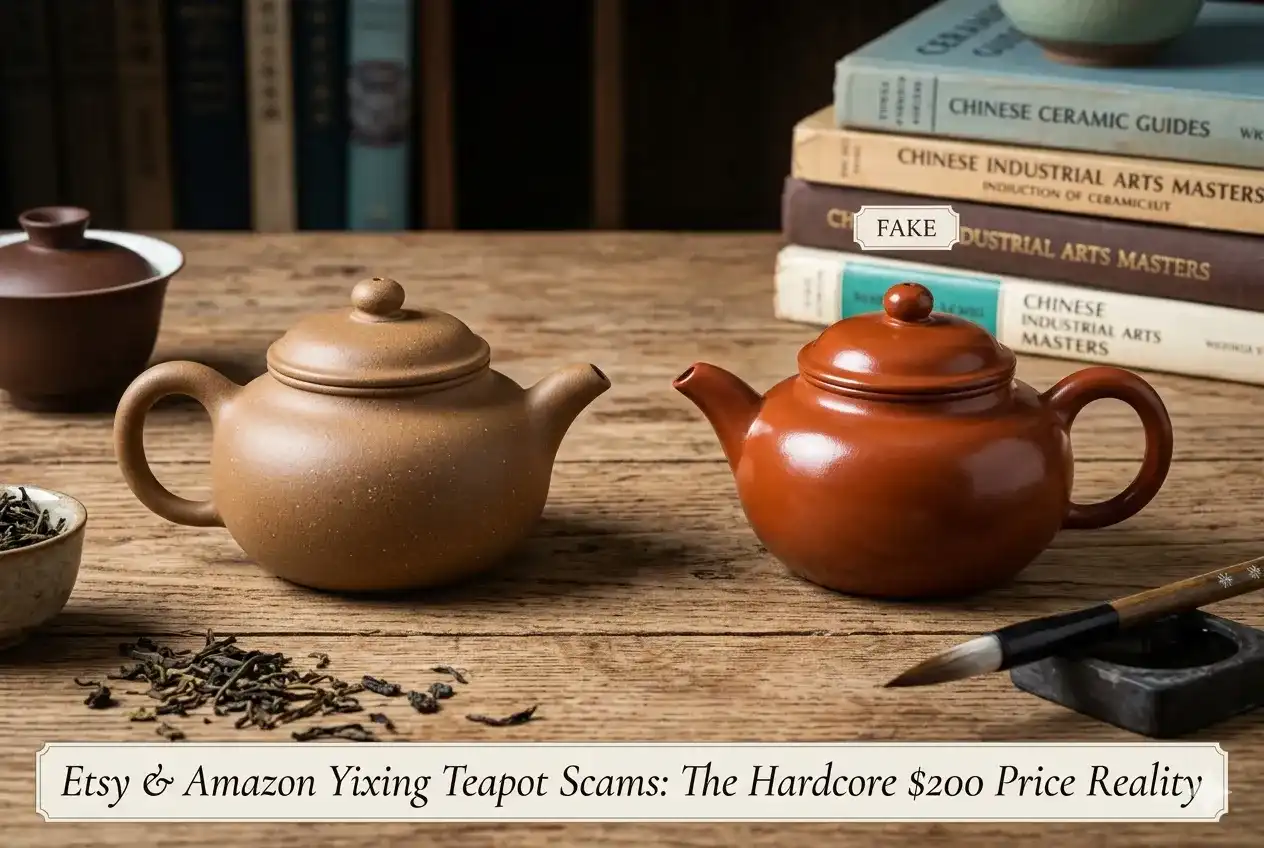
Ninety-nine percent of the "authentic, artisan-made" Yixing teapots listed under $100 on Etsy and Amazon are chemical illusions manufactured from wheel-thrown slip-cast mud. Under the current 2026 raw material pricing in Dingshu Town, a genuine Yixing teapot fashioned from Original Ore Zisha cannot physically exist at these retail points. To acquire a legitimate entry-level piece crafted via the Semi-Handmade technique using clean, unadulterated Zini, Duanni, or Hongni, a global consumer must accept a baseline defense line of $200. This numerical reality is dictated by fixed physical and logistical costs, not arbitrary marketing premiums.
The financial matrix of a genuine cross-border Yixing teapot involves fixed economic constraints that mass market algorithms actively obscure. High-quality mined Original Ore costs between $15 to $40 per kilogram before processing, depending on whether it is standard Dicaoqing or aged Jiangpo. A competent artisan in Yixing charges a minimum of $40 to $60 in labor just to hand-mold a standard Semi-Handmade vessel using auxiliary plaster molds. When you add specialized kiln firing fees, local brokerage margins, domestic sorting, international air freight with shock-absorbent packaging, platform transaction commissions (ranging from 6.5% on Etsy to 15% on Amazon), and a baseline break-even margin, the mathematical floor for a merchant to land a real teapot on Western soil is $200.
Any vessel retailing below $200 on these open platforms bypasses these mineral and artisan safeguards entirely. These cheap alternatives are produced using industrial slip-casting or automated roller-forming methods, where non-Zisha common clay is liquified into mud slurry. True Zisha clay possesses low plasticity and a high Shrinkage Rate, making it physically impossible to slip-cast without collapsing. To force common mud into a teapot mold for mass production, factories mix in liquid sodium silicate as a deflocculant alongside chemical metallic pigments. Purchasing these under-$200 items does not support a traditional artisan; it subsidizes industrial chemical operations that undermine traditional Gongfu tea brewing.
The $500 Threshold and the $1000+ Reality of True Fully Handmade Craftsmanship
Authentic Fully Handmade Yixing teapots do not exist in the $200 to $450 price tier on mass-market platforms. A consumer must treat $500 as the absolute minimum entry threshold to obtain a vessel crafted completely by hand, while premium, investment-grade Fully Handmade masterpieces safely command $1000 or more. The physical execution of the Fully Handmade method requires an artisan to build the teapot entirely from scratch, beating the clay into a flat sheet, forming the mud cylinder, and shaping the profile using only hand tools like wooden mallets and horn spatulas. This process demands dozens of hours of focused structural labor per piece.
The stark difference between the entry-level $500 ticket and the $1000+ premium tier reflects the structural risk and artisan skill involved. A standard $500 Fully Handmade teapot is typically crafted by unranked or early-career artisans in Dingshu utilizing stable, standard-grade Zini or Hongni ores. At this level, the Firing Temperature yields a standard Porosity profile, but the aesthetic lines and structural tension are basic. Conversely, once a teapot crosses the $1000 milestone, you are paying for scarce, pristine ores like authentic Zhuni or pristine Dicaoqing, coupled with advanced engineering that achieves optimal thermal retention and exceptional pour dynamics. These higher-tier teapots develop a deep, rich Patina over time, rewarding the practitioner with enhanced tea flavors.
Open marketplaces like Etsy are saturated with listings priced between $150 and $450 that claim to be "100% Fully Handmade by Master Potters." This is a highly profitable industry deception designed to exploit the information gap between domestic creators and Western collectors. Unscrupulous sellers take mass-produced Semi-Handmade or machine-stamped pots and list them at these intermediate prices to make them appear authentic. If your budget is firmly below $200, you should avoid the Zisha category entirely on these platforms and purchase a high-quality porcelain Gaiwan instead. If you are ready to invest over $500, you must demand a rigorous, transparent inspection protocol and verifiable mineral provenance rather than relying on algorithmic recommendations.
Chemical Duplication vs. Mineral Porosity: How Marketplace Algorithms Weaponize Aesthetics
The visual appeal of fake teapots on Amazon and Etsy is a calculated aesthetic deception achieved through industrial chemical manipulation. Natural, untreated Zisha ore is defined by its iconic dual-porosity system, featuring both open inter-crystalline pores and closed intra-articular pores. This structural matrix gives genuine Zisha an overall Porosity of 10% to 15%, allowing the clay to breathe, regulate heat, and absorb volatile tea oils. Mass-market fake pots completely lack this thermodynamic capability because their industrial clay formulas are heavily adulterated.
Industrial counterfeiters mix toxic metallic oxides into low-grade white or yellow earthenware clay to mimic the rich, earthy tones of authentic Zisha minerals. They use industrial barium carbonate to eliminate surface scum, manganese oxide to synthesize dark Zini, and cobalt oxide to create artificial green Lvni. To give these chemically altered clays a glossy, aged look straight out of the box, factories dip the fired teapots into industrial liquid paraffin or apply thin layers of high-temperature glass frits. This processing creates a non-porous, glassy surface layer that permanently seals the vessel, rendering it incapable of absorbing tea oils or developing an authentic Patina.
The long-term functional failure of these chemical pots becomes obvious within a few weeks of use. A genuine Yixing teapot safely balances thermal shock, maintaining heat during Gongfu tea sessions while releasing steam through its micro-pores. A chemically altered slip-cast pot, which has a compromised porosity under 5% due to added chemical deflocculants, traps heat unevenly and often introduces a distinct metallic, chemical odor to the tea liquor. Furthermore, because its surface is permanently vitrified by industrial coatings, it cannot interact with tea organic compounds. It remains shiny and slick, failing to ever develop the sought-after, soft luster of a seasoned teapot.
Inside the Scam Playbook: Debunking Fake "Joint Lines" and AI-Generated Certificates on Etsy
Marketplace scammers have upgraded their production techniques to directly counterfeit the traditional physical markers of handmade craftsmanship. Historically, buyers were told to check for a vertical joint line inside the kettle's back wall or search for internal tool marks to verify a Fully Handmade origin. Today, modern industrial factories in Dingshu use advanced composite molds that stamp fake joint lines, artificial structural irregularities, and mock tool marks directly into the wet slip-cast clay. These pre-formed marks give the illusion of traditional hand-assembly to an untrained buyer looking at a product photo on a screen.
The inclusion of an "Official Master Artist Certificate" with a red wax stamp has become one of the most common deceptions on Amazon and Etsy. These certificates are mass-printed in local logistics hubs or generated using AI templates, featuring fictional artisan names or illegally using the credentials of retired Dingshu potters. They are packaged alongside colorful booklets and plastic identity cards to create a false sense of security. Western buyers who are unfamiliar with the official registry of the Chinese Industrial Arts Masters and the rigorous provincial ranking systems frequently fall victim to these elaborate presentation packages.
To successfully navigate these open platforms, you must rely on a rigorous physical assessment rather than promotional packaging or certificate printouts. When exploring how to safely buy genuine Yixing zisha teapot options, remember that true quality reveals itself through subtle physical details: natural mineral grit variations, structural tool undercuts around the inner spout junction, and honest, non-uniform shrinkage wrinkles. Genuine teapots showcase an organic harmony between clay and form that mass-production lines simply cannot duplicate. Protecting your tea session requires a strict rejection of algorithmic discounts and a commitment to verified, traceable cost realities.