Have you ever wondered why the exact same loose-leaf tea tastes remarkably vibrant when brewed in a tiny, palm-sized vessel, yet turns flat or uninspiring in a standard western teapot? In the authentic ritual of tea brewing, finding the perfect gongfu tea yixing pot is never just about aesthetics—it is a calculated boundary where physics, fluid mechanics, and micro-economics intersect.
For a long time, Western tea culture has assumed that a larger vessel yields better value. However, if you are sourcing premium, high-mountain Oolongs or aged Pu-erh, oversized vessels are the silent killers of extraction. To transition from a casual drinker to a true connoisseur, your baseline metric must change. The best yixing teapot for gongfu tea does not live on a shelf of massive teaware—it operates strictly in the sub-150ml realm. It is not an aesthetic choice; it is an engineering requirement.
The Physics of the Sub-150ml Threshold
To understand why a small vessel performs flawlessly, we have to look at the surface-area-to-volume ratio ($A/V$) and thermal convection. When boiling water hits tea leaves, you require an immediate, high-intensity thermal shockwave to break open the leaf's cell walls and release essential oils. In a massive 300ml pot, the volume of water is too high; the hot water at the core takes too long to circulate to the colder edges of the clay wall. The heat dissipates sluggishly, resulting in a stagnant thermal dead-zone where the leaves are essentially "stewed" rather than cleanly extracted.
When you drop below the 150ml threshold—ideally utilizing a 100ml or 120ml vessel—the fluid dynamics inside the chamber change entirely. The kinetic energy of pouring boiling water into a compressed 100ml chamber creates a localized, rapid turbulent flow. The water molecules bounce off the nearby Zisha walls instantly, forcing tightly rolled leaves to unfurl evenly and rapidly without dropping the core temperature。
Shuiping: The Ultimate Gongfu Standard
Within this sub-150ml realm, one shape reigns supreme as the thermodynamic benchmark: the Shuiping (水平 / Level Pour). The historical genius of the Shuiping shape lies not in its minimalism, but in its absolute geometric symmetry. Originally engineered to float perfectly level on the surface of hot water during the traditional Chaozhou "can-warming" stage, this strict balance ensures that when boiling water is introduced, thermal radiation distributes with absolute centripetal uniformity. There are no cold corners or dead angles inside a Shuiping pot.
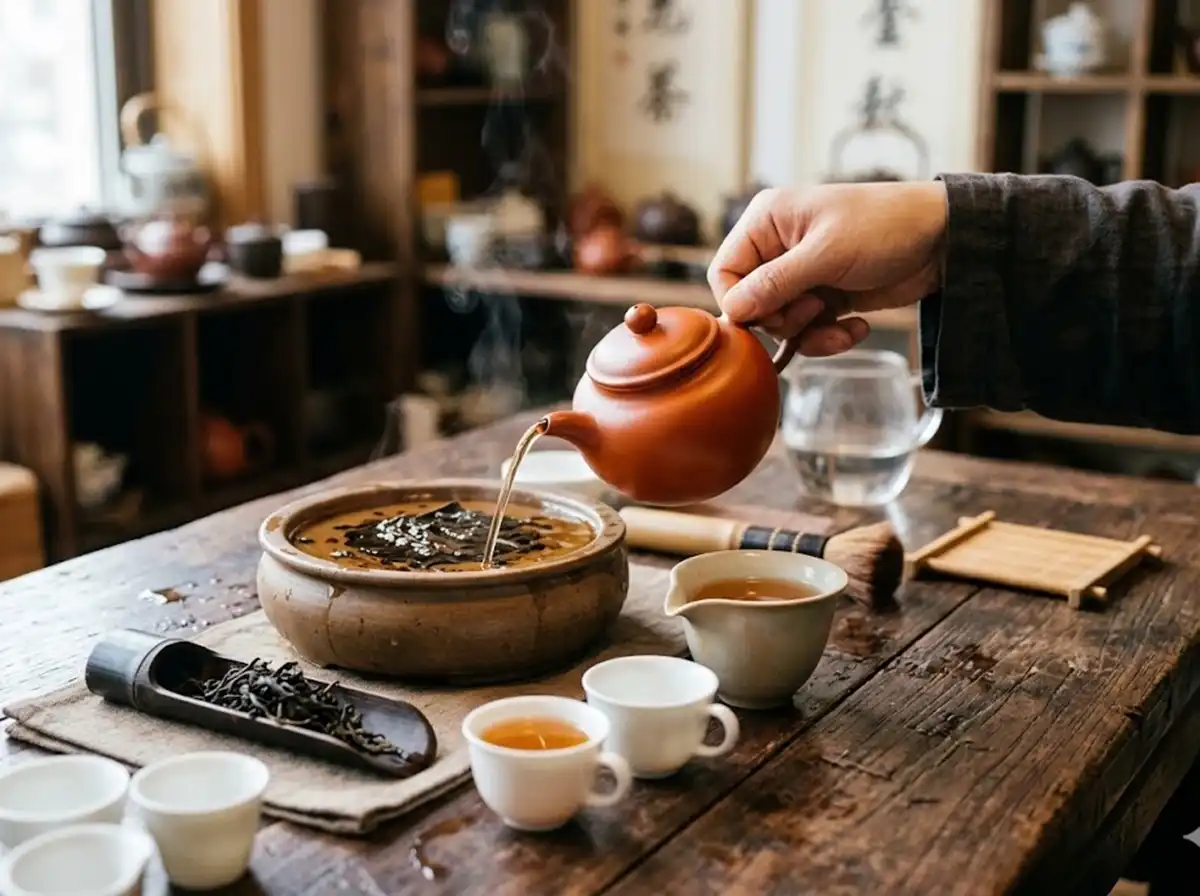
Furthermore, the Shuiping features a distinctive straight, cannon-style spout. From the perspective of fluid mechanics, a straight spout offers the path of least resistance, maintaining a perfectly linear flow trajectory. When brewing high-aroma, volatile teas like Phoenix Dancong or Yancha, timing is measured in seconds; a delay of a single breath can over-steep the leaf into bitterness. The sub-150ml Shuiping provides an instantaneous, unrestricted pour, draining the chamber completely in seconds to lock in the fragile, aromatic "top notes" of the tea while safely separating the leaf from residual heat.
Other classic shapes complement this realm through alternative geometries. The spherical Xishi (西施) possesses the smallest possible surface area for its volume, acting as an unparalleled thermal incubator for heavy-fermentation teas like Shou Puerh. Meanwhile, the triangular Shipiao (石瓢) uses its wide, low base to draw heat from the bottom up while its tapering rim compresses volatile aromatic compounds right at the pour point.
Clay Mineralogy: Tuning Your Thermal Conductivity
The structural size of your teapot must be intentionally paired with the correct micro-porosity and clay vitrification. Not all Zisha behaves the same way under thermal stress:
| Clay Type (泥料) | Density & Vitrification | Thermal Performance | Ideal Tea Pairing |
|---|---|---|---|
| Zhuni (朱泥) | High Vitrification / Dense Structure | Fast conductivity ($k$), sharp heat transfer, zero aromatic absorption. | Rock Tea (Yancha), Phoenix Dancong, High-Aroma Oolongs. |
| Zini (紫泥) | Medium Porosity / Dual-Pore System | High specific heat capacity ($C_p$), steady insulation, rounds out harshness. | Aged Sheng Puerh, Shou Puerh, Heavy-Roast Oolongs. |
| Duanni (段泥) | High Porosity / Coarse Texture | Moderate retention, high breathability, absorbs high astringency. | Raw Puerh, Aged White Tea, Green Tea. |
The Leaf-Saver Economics: Micro-Financial Analysis
Let’s look at the dry, practical financial layout. Sourcing authentic, high-tier single-origin tea in the West is an expensive investment. Premium roasting styles or limited-batch terroirs easily cost anywhere from $0.50 to $2.00 per gram. Gongfu brewing demands a dense leaf-to-water ratio—typically around 1 gram of tea for every 15ml to 20ml of water. If you calculate the long-term consumption math, the financial advantage of sub-150ml pots becomes blindingly clear:
- The 250ml "Standard" Pot: To achieve an authentic Gongfu flavor profile, you must dose roughly 13 to 15 grams of leaf per session. If you purchase a premium $50 tin containing 100 grams of Rock Tea, your supply is completely exhausted in just 6 or 7 sessions. Your cost per tea ritual is a staggering $7.14.
- The 100ml DXY Micro-Pot: To achieve the exact same flavor intensity, you only need to dose 5 to 6 grams of leaf. That identical $50 tin now yields over 16 separate, highly complex tea sessions. Your cost per ritual drops to $3.12.
By switching to a smaller vessel, you cut your raw material consumption by more than half without sacrificing flavor complexity. Over the span of three to four months of daily brewing, the money saved on your leaf budget entirely pays off the upfront purchase of a premium, hand-crafted DXY Zisha pot.
The Versatility Spectrum: Navigating the 150ml–250ml Divide
Does this mean larger pots have no place in a serious collection? Not at all. It is simply a matter of shifting your operational environment. A pot ranging from 150ml to 250ml is the absolute sweet spot for social sessions. When you have an extra guest or a partner joining your ritual, a single pour from a 180ml pot fills two traditional 80ml tasting cups cleanly to the brim. It maintains the social momentum of the conversation without forcing the host to constantly reload a micro-vessel.
The Solo Realist's "Half-Pour Hack"
If you currently only own one versatile 200ml Yixing pot but wish to enjoy a solitary session without burning through 12 grams of expensive tea, you can override the volume via a simple physical trick. Measure out 5 to 6 grams of tea (the 100ml standard) and purposefully pour your boiling water only halfway up the body of the teapot, leaving the top half empty. The empty space in the upper chamber fills immediately with trapped steam, creating a localized "Air Jacket"—a natural thermal barrier layer. While you will experience a minuscule amount of heat loss due to vapor expansion in the headspace, the functional liquid volume matches that of a micro-pot. This simple hack breaks the rigid dogmas of teaware sizing, allowing a standard sharing-sized pot to mimic the thriftiness and precision of a solo instrument.
The DXY Verdict
When searching for teaware, look past purely ornamental traits or exaggerated capacities. Assess your daily routine. If 90% of your tea sessions are quiet, solitary moments of focus, invest your confidence in a sub-150ml vessel. Look for structural balance: a symmetrical Zhuni Shuiping for unparalleled aromatic lift, a rounded Xishi for heat retention, or a grounded Shipiao for structural clarity. Let physics handle the thermodynamics, while the small chamber takes care of your wallet.